Manitoba Hydro’s Integrated Resource Plan (IRP) is a 10-year plan with the goal of achieving a net-zero economy by 2050. The IRP outlines how Manitoba’s future energy needs will be met through a strategic roadmap. This plan relies heavily on consumer solutions and natural gas. The Public Hearing Utility Board has been reviewing this plan, and the Wa Ni Ska Tan Alliance of Hydro Impacted Communities was approved as an intervenor by the PUB
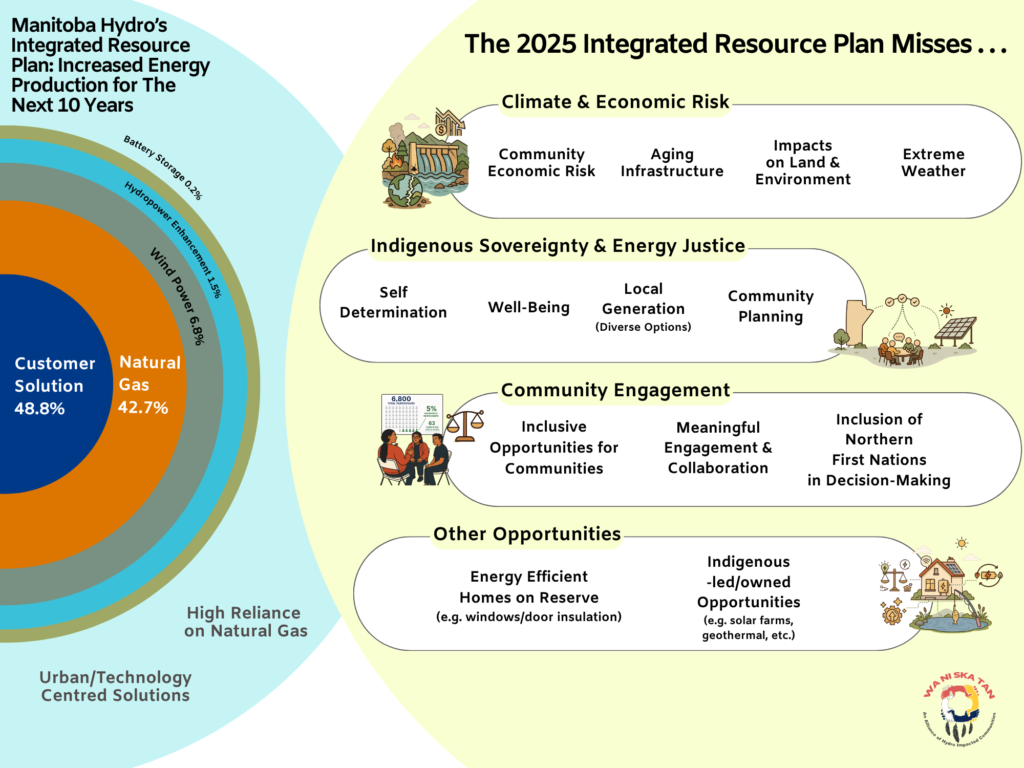
Click here to read our 4-page summary report on the 2025 IRP or open the accordion bar below to learn more.
The Integrated Resource Plan (IRP) is a 10-year development plan that explains how Manitoba energy needs will be met in the future. Manitoba Hydro’s 2025 IRP compares the current and recommended resources with forecasts of future energy needs. It shows that Manitoba needs different sources of capacity and energy, therefore, Manitoba Hydro created a plan to meet these needs.
This 10-year plan aims to add about 1760MW of accredited capacity, increasing total capacity from 6200MW to about 7200MW. The plan focuses on two major energy strategies, including customer solutions and natural gas/biomethane-fueled combustion turbines.
Why is it important for us?
• Manitoba Hydro’s IRP is a 10-year plan with the goal of a net-zero economy by 2050.
• Manitoba Hydro’s IRP includes plans that can affect our electricity bill, our environment, and economy, which will shape our future for many years.
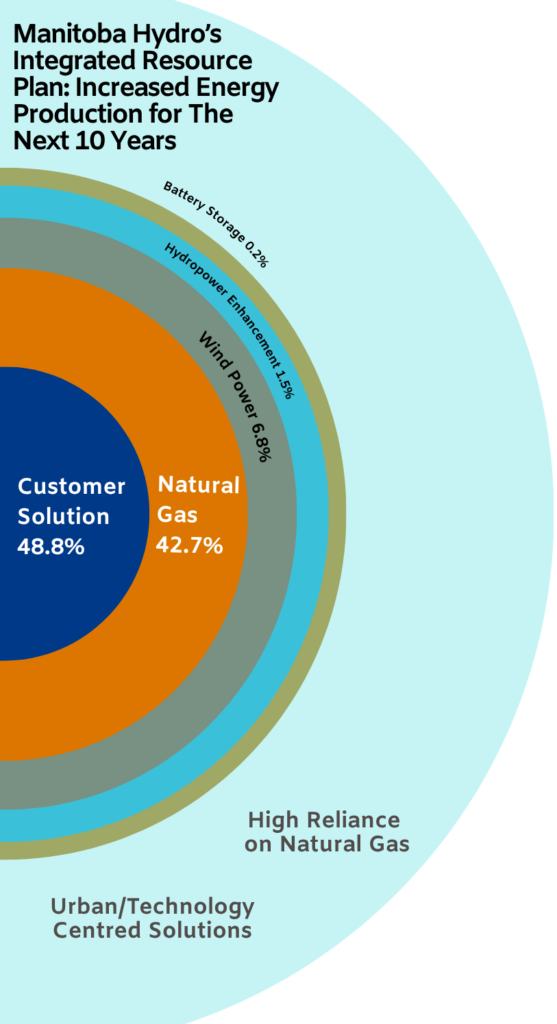
1. Customer-side Solutions (48.8%)
2. Natural Gas/Biomethane- Fueled Combustion Turbines (42.7%)
3. Wind Power (6.8%)
4. Hydropower Enhancement (1.2%) & Battery Storage (0.2%)
Although the IRP can provide important opportunities for an equitable energy future in Manitoba, its current plan has several shortcomings in fully recognizing these opportunities:
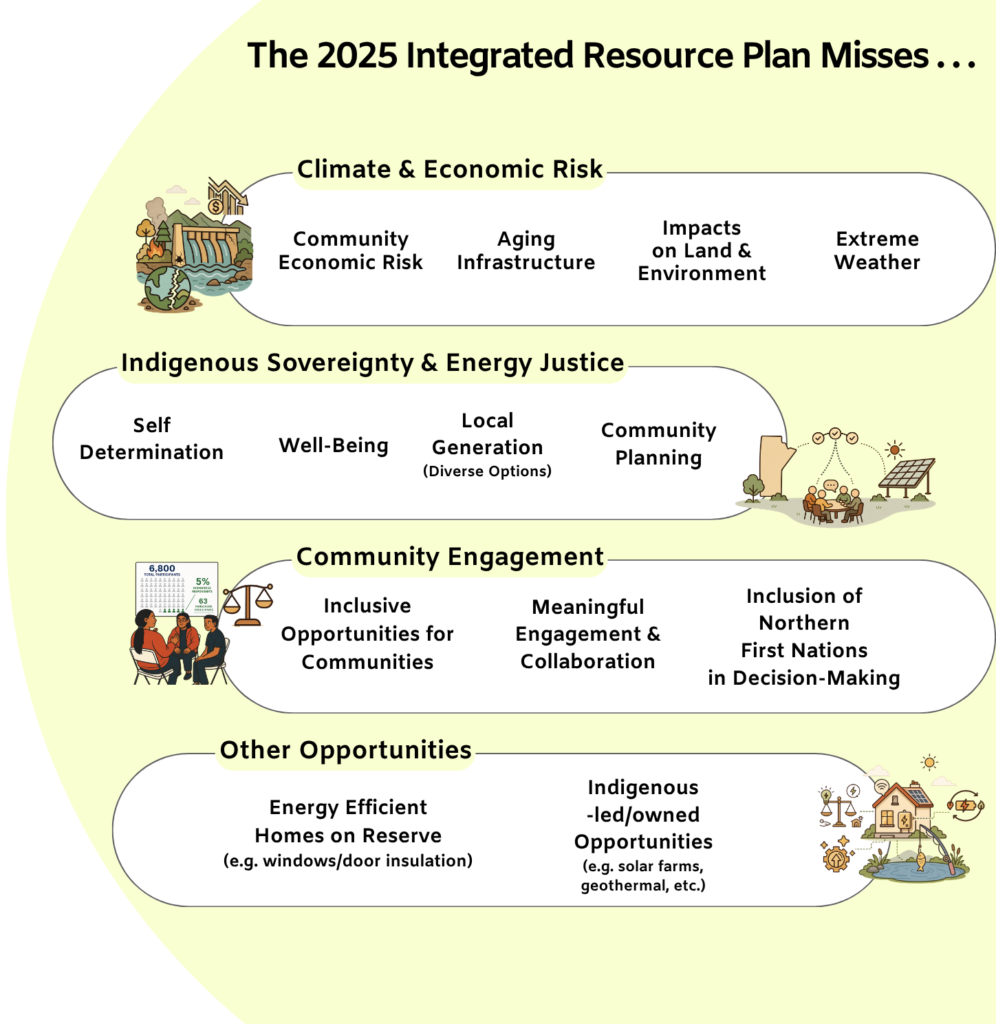
Shortcomings in the 2025 IPR
1. Lack of Engagement with First Nations
• Indigenous communities, especially hydro-impacted First Nations, have largely been excluded from participating in this process
• There is a lack of effort to include isolated communities (including northern Manitoba) and at the grassroots level.
• Customer-side solutions, mostly through Efficiency Manitoba, largely exclude northern Indigenous communities.
Current public engagement efforts remain at the level of “informing,” and to some degree “consultation,” rather than moving toward meaningful collaboration or empowerment.
2. Did Not Properly Address Potential Risks
• The IRP is largely urban/technology-centred, and thus underestimates future uncertainty and climate-related risk.
• The IRP has a clear contradiction between increasing reliance on natural gas and claims that the IRP is advancing toward net-zero goals.
• Such oversights reflect economic, technological, and political risks.
3. Overlooked Other Opportunities/Alternatives
• Many other Indigenous-led and owned opportunities have been overlooked in part because of the shortcomings in public engagement.
• Those opportunities would include not being restricted to solar farms, geothermal, and micro dams as well as cross-community networked diesel generators.
Indigenous peoples from Manitoba and Northwestern Ontario affected by hydro are working with Wa Ni Ska Tan to address hydro-related risks and to ensure that critical planning and operational decisions meaningfully reflect their perspectives and concerns. The IRP represents an important vehicle to redress past and ongoing harms but also to generate a welcoming and inclusive space as related to an equitable energy future in this province. Through our partnership, Wa Ni Ska Tan has seek to intervene in this process to help ensure:
As an intervenor, Wa Ni Ska Tan was taking a role in: 1) critically evaluating Manitoba Hydro’s IRP engagement with Indigenous rights holders and the general public, 2) evaluating a systemic underestimation of key risks and uncertainty in the plan, 3) evaluating whether the plan reflects the value of economic resurgence.