Manitoba Hydro’s Integrated Resource Plan (IRP) is a 10-year plan with the goal of achieving a net-zero economy by 2050. The IRP outlines how Manitoba’s future energy needs will be met through a strategic roadmap. This plan relies heavily on consumer solutions and natural gas. The Public Hearing Utility Board has been reviewing this plan, and the Wa Ni Ska Tan Alliance of Hydro Impacted Communities was approved as an intervenor by the PUB
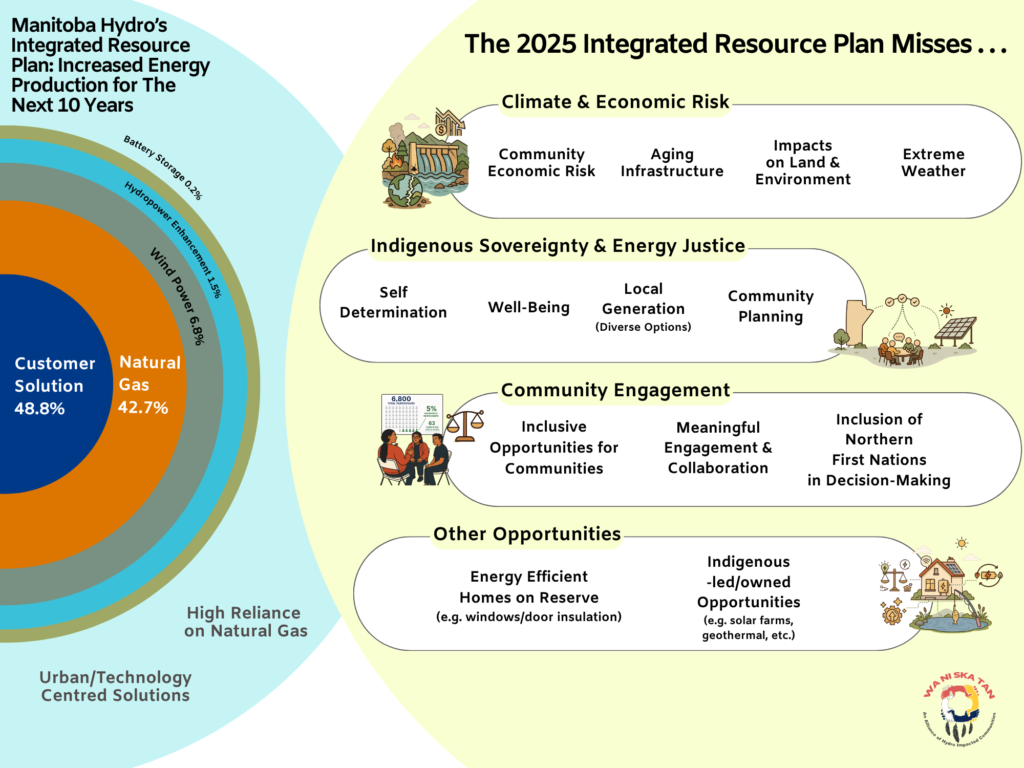
Click here to read our 4-page summary report on the 2025 IRP or open the accordion bar below to learn more.
The Integrated Resource Plan (IRP) is a 10-year development plan that explains how Manitoba energy needs will be met in the future. Manitoba Hydro’s 2025 IRP compares the current and recommended resources with forecasts of future energy needs. It shows that Manitoba needs different sources of capacity and energy, therefore, Manitoba Hydro created a plan to meet these needs.
This 10-year plan aims to add about 1760MW of accredited capacity, increasing total capacity from 6200MW to about 7200MW. The plan focuses on two major energy strategies, including customer solutions and natural gas/biomethane-fueled combustion turbines.
Why is it important for us?
• Manitoba Hydro’s IRP is a 10-year plan with the goal of a net-zero economy by 2050.
• Manitoba Hydro’s IRP includes plans that can affect our electricity bill, our environment, and economy, which will shape our future for many years.
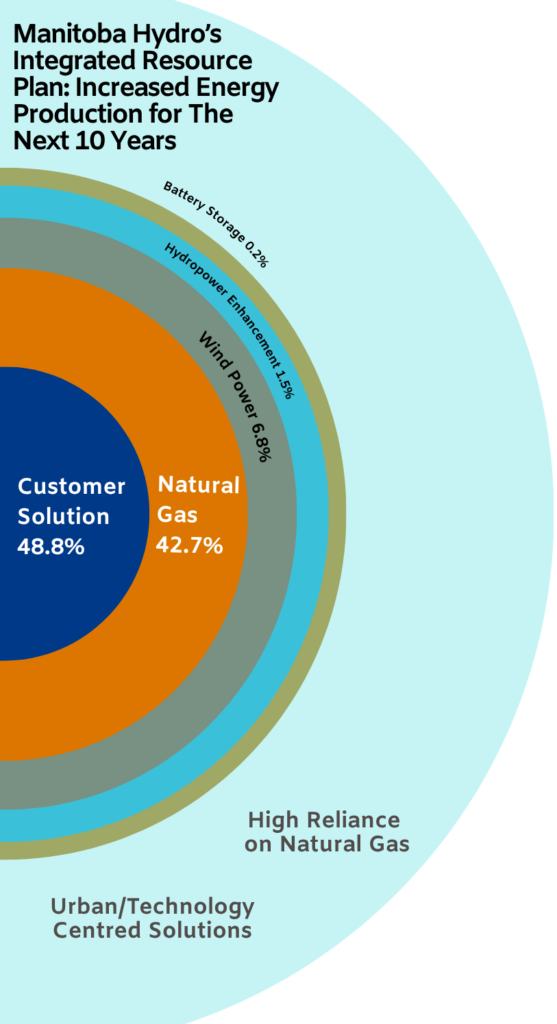
1. Customer-side Solutions (48.8%)
2. Natural Gas/Biomethane- Fueled Combustion Turbines (42.7%)
3. Wind Power (6.8%)
4. Hydropower Enhancement (1.2%) & Battery Storage (0.2%)
Although the IRP can provide important opportunities for an equitable energy future in Manitoba, its current plan has several shortcomings in fully recognizing these opportunities:
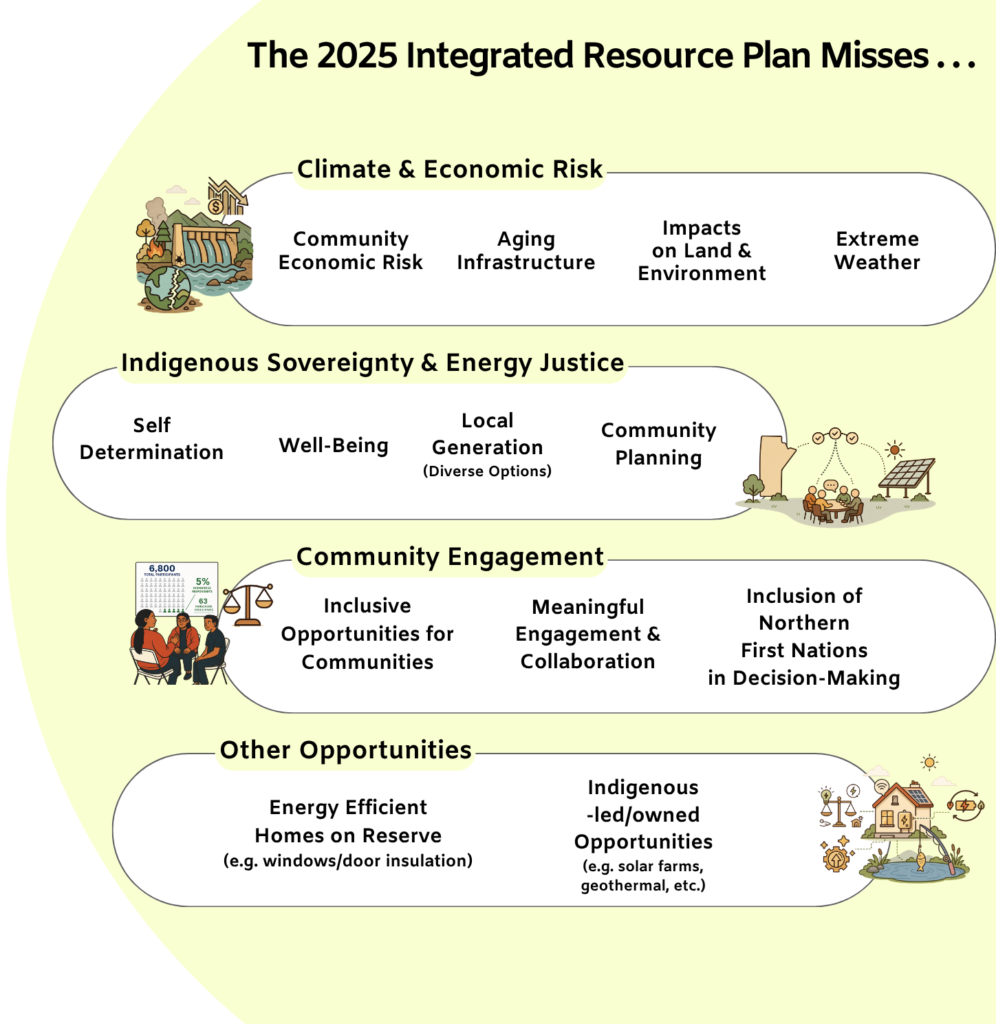
Shortcomings in the 2025 IPR
1. Lack of Engagement with First Nations
• Indigenous communities, especially hydro-impacted First Nations, have largely been excluded from participating in this process
• There is a lack of effort to include isolated communities (including northern Manitoba) and at the grassroots level.
• Customer-side solutions, mostly through Efficiency Manitoba, largely exclude northern Indigenous communities.
Current public engagement efforts remain at the level of “informing,” and to some degree “consultation,” rather than moving toward meaningful collaboration or empowerment.
2. Did Not Properly Address Potential Risks
• The IRP is largely urban/technology-centred, and thus underestimates future uncertainty and climate-related risk.
• The IRP has a clear contradiction between increasing reliance on natural gas and claims that the IRP is advancing toward net-zero goals.
• Such oversights reflect economic, technological, and political risks.
3. Overlooked Other Opportunities/Alternatives
• Many other Indigenous-led and owned opportunities have been overlooked in part because of the shortcomings in public engagement.
• Those opportunities would include not being restricted to solar farms, geothermal, and micro dams as well as cross-community networked diesel generators.
Indigenous peoples from Manitoba and Northwestern Ontario affected by hydro are working with Wa Ni Ska Tan to address hydro-related risks and to ensure that critical planning and operational decisions meaningfully reflect their perspectives and concerns. The IRP represents an important vehicle to redress past and ongoing harms but also to generate a welcoming and inclusive space as related to an equitable energy future in this province. Through our partnership, Wa Ni Ska Tan has seek to intervene in this process to help ensure:
As an intervenor, Wa Ni Ska Tan was taking a role in: 1) critically evaluating Manitoba Hydro’s IRP engagement with Indigenous rights holders and the general public, 2) evaluating a systemic underestimation of key risks and uncertainty in the plan, 3) evaluating whether the plan reflects the value of economic resurgence.
Open the accordion to learn more about Wa Ni Ska Tan’s works
Les Dysart
Les Dysart is the Chief Executive Officer of the Community Association of South Indian Lake. His expertise includes preand post-hydro impacts on humans and non-humans, and their connections to socio-cultural, economic, political and other environmental issue; flooding, fluctuation and flow of water levels – natural and human- made (reservoirs); hydroelectric infrastructure, community consultation, engagement, land use, and licensing agreement understanding and analysis.
As a life-long member of the fishing community and band member of OPipon- Na-Piwin Cree Nation, Dysart has life-long experience and first-hand observations of the construction, implementation, and operation of the Churchill River Diversion Project. He has participated in most processes related to project implementation, licensing, and review of Manitoba Hydro projects. Dysart has also provided testimony, memos, and presentations to government regarding decisions and debate on hydro projects on provincial, federal, and international levels.
Daniel Gladu Kanu
Daniel Gladu Kanu is a member of Animakee Wa Zhing First Nation. He has worked with First Nations across Manitoba and Canada to develop community-led monitoring programs including fish habitat assessment, wetland restoration, and water quality monitoring.
Currently he is the Executive Director for the Lake Winnipeg Indigenous Collective (LWIC), an initiative started by 14 First Nations around Lake Winnipeg to ensure that Indigenous perspectives, knowledge and values inform environmental decision-making. LWIC works directly with five First Nations as part of an Indigenous environmental monitoring network that aim to build capacity and coordinate monitoring and restoration efforts around Lake Winnipeg. As a network, Indigenous partners have both a unique perspective and deep commitment to ensuring the health of Lake Winnipeg.
Steph McLachlan
Stephane McLachlan is internationally recognized as a leading expert in public engagement when it comes to natural resources, environmental health, and the wellbeing of equity-seeking groups. This work has most recently focused on collaborations and Partnerships with Indigenous communities and organizations in Manitoba and beyond, although such approaches have included other under-represented groups including farmers and ranchers, and urban food providers. Much of his research has focused on energy production including hydro, critical minerals and oil and gas.
In addition to focusing on inequities and socioenvironmental impacts related to energy production, Dr McLachlan has helped innovate and support community led responses to these impacts including planning and monitoring. He has further developed strategies and tools for amplifying community voice including surveys, photovoice, documentary film, community video and advocacy.
Elder Ellen Cook
Elder Ellen Cook of Misipawistik Cree Nation (Grand Rapids) is a Cree Elder, storyteller, and language keeper. Elder Ellen is also Co-Chair of Interfaith Council on Hydropower, a council of churches that raise public awareness, promote resource sustainability, and advocate for justice and fairness for Indigenous and northern communities negatively affected by major hydropower developments.
Melanie Molin
Melanie Molin of Mathias Colomb Cree Nation is a knowledge keeper and land-based educator. She is currently a graduate student at the University of Manitoba in the Environmental Conservation Lab, while also teaching at the University College of the North in The Pas. In her research, she hopes to understand the importance of intergenerational knowledge, the impacts of hydropower development, and the community strength that sustains harmony on the land.
Tanya McDougall
Tanya Dawn McDougall of St. Theresa Point Ansininew Nation is a lifelong scholar. Tanya speaks Anisinineemowin and she holds two master’s degrees, one in Educational Administration from the University of Manitoba and one in School and Applied Child Psychology from the University of Calgary. Tanya is a co-director of Wa Ni Ska Tan and is a Wellness Coach and Advocate for her community.
Elder Nelliane Cromarty
Elder Nelliane Cromarty of St. Theresa Point Ansininew Nation was born on a trapline at Island Lake, Manitoba. In 1969, as a teaching assistant, she began incorporating the language into the school in her home community of St. Theresa Point. She continues working there today as an Elder Advisor. Nelliane has a personal and deeply passionate connection for this land and territory.
Mervin Garrick
Mervin Garrick of Pimicikamak Cree Nation is a former Councillor and spokesperson. He has long called on Manitoba Hydro, along with the federal and provincial governments, to honour the Northern Flood Agreement, which originally included five First Nations affected by flooding caused by hydroelectric projects on the Nelson and Churchill rivers.
Elder Rita Monias
Elder Rita Monias of Pimicikamak Nation (Cross Lake) grew up on the Nelson River and is a lifelong advocate of environmental justice. Elder Rita has a unique perspective as someone who remembers life before hydropower development in Cross Lake.
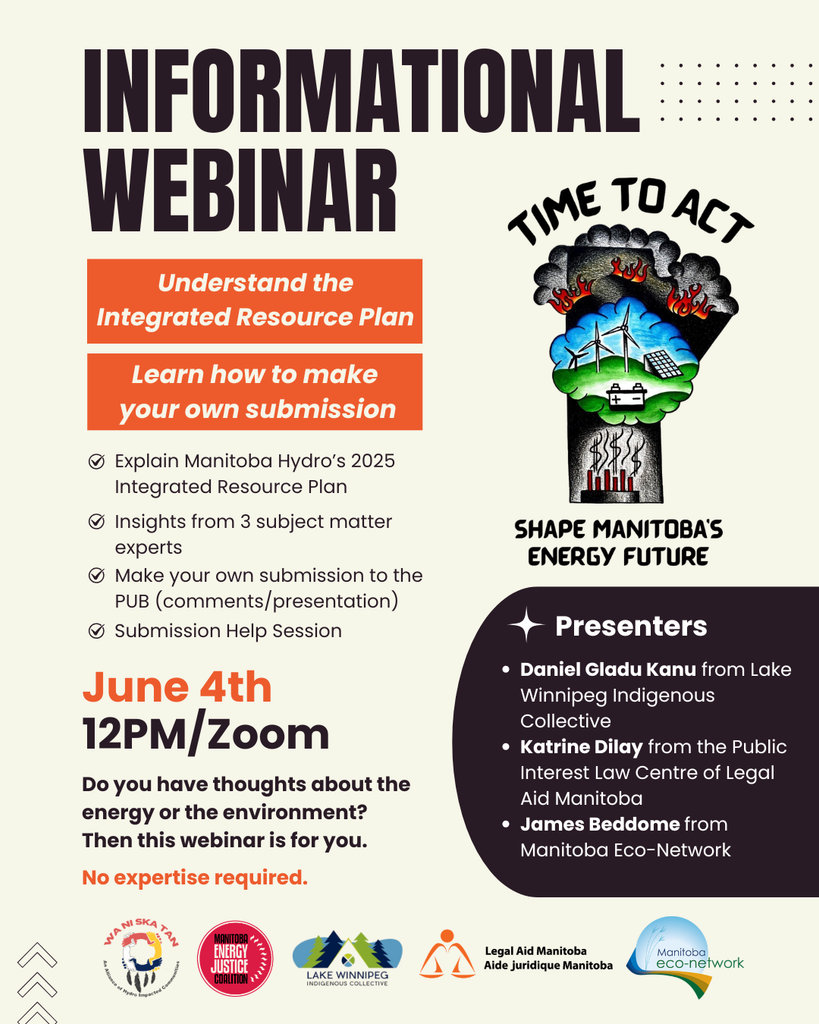
Collaborated with Manitoba Energy Justice Coalition, Wa Ni Ska Tan helped host the informational webinar to increase public awareness of the IRP and assist people in participating in the review process. In this webinar, Katrine Dilay (Public Interest Law Centre of Legal Aid Manitoba), James Beddome (Manitoba Eco-Network), and Daniel Gladu Kanu (Lake Winnipeg Indigenous Collective) presented their perspectives as intervenors on the IRP.
After their presentation, Yiseul Kang (Environmental Conservation Lab & Manitoba Energy Justice Coalition) provided information about the public hearing process and helped people understand how to submit their comments or presentation applications – click here to access the public hearing information.
More than 100 people joined, and we continued to connect with individuals who needed help participating in the review process.
Insufficient communication and engagement with northern communities in Manitoba was a notable weakness of Manitoba Hydro’s Integrated Resource Plan (IRP).
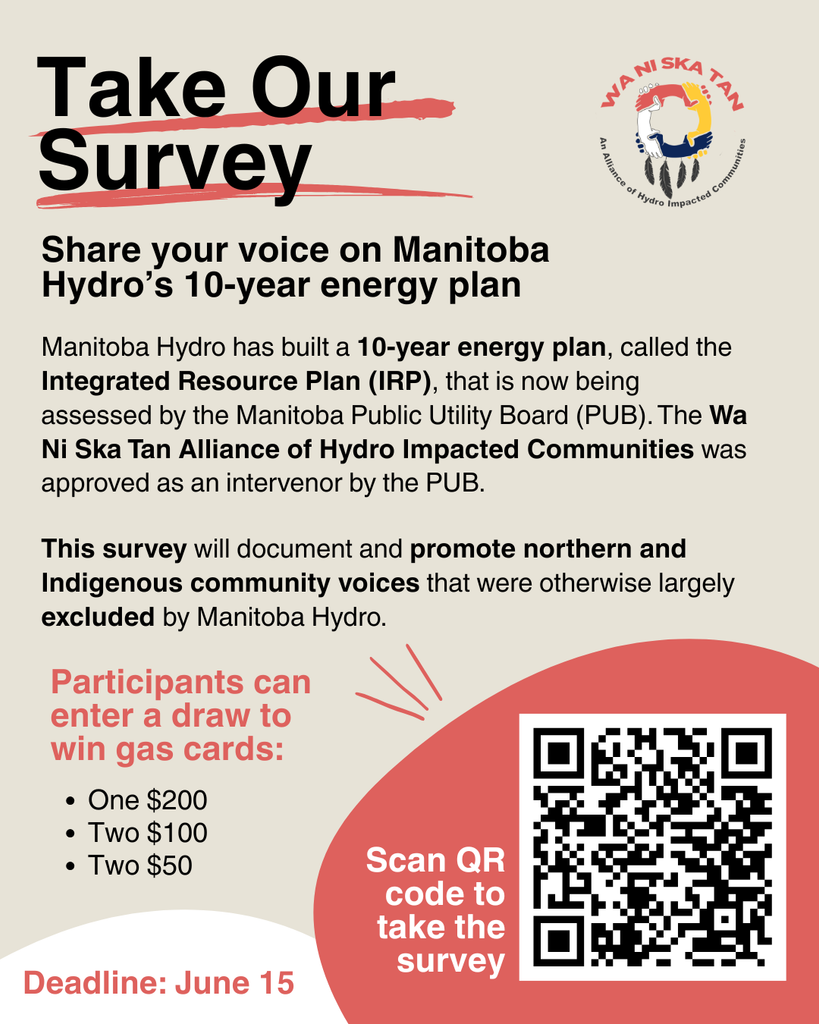
To amplify the voices of northern and Indigenous communities that were largely overlooked by Manitoba Hydro, Wa Ni Ska Tan developed our own survey.
The results of this survey were later used to compare against Manitoba Hydro’s surveys, revealing disparities in engagement with northern communities. The survey results also helped to develop recommendation that highlights the importance of upholding Indigenous rights and sovereignty in the energy planning:
“Recommendation 14: The Manitoba Hydro recognize the importance of Indigneous rights and sovereignty in its planning and management activities, rather than treating Indigenous communities as yet another stakeholder, and in so doing explore ways of equitable collaborating and partnering with communities in future iterations of the IRP […].”
This section lists the evidence that was submitted to the Public Utility Board for the IRP review process. Click each button to read or watch written/oral evidence.
“[…] some of the ways that planning processes can exclude and harm Indigenous people that could further perpetuate negative attitudes between Manitoba Hydro and Indigenous communities”
– Daniel Galdu Kanu, 2026
“There is a hard reality that [Manitoba] Hydro and the Province [of Manitoba] are not dealing with. And they seem to think this IRP process is starting fresh. Well it’s not fresh because there is still those harsh realities we have to live with […]”
– Les Dysart, 2026
“Before future IRP cycles proceed, Manitoba Hydro should prioritize relationship building with First Nations and explicitly recognize Indigenous rights and equity; only then should the process incorporate past, present, and predicted environmental impacts into planning and decision-making for the next IRP iteration.”
– Steph McLachlan, 2026
“This resource plan they’re talking about, again we’re left behind. […] There’s been no communication. No dialogue. What’s happening here is our treaties were violated.”
– Elder Jackson Osborne, Pimicikamak Cree Nation, 2026
“How am I going to talk about the future without being able to talk about the past?[…] If they want to talk about the future, like they want to talk to me, I have to talk about the past .”
– Donald Dysart, O-Pipon-Na-Piwin Cree Nation, 2026
“While Manitoba Hydro promotes its operation as environmental-friendly, the ongoing disturbance, destruction, and contamination of the land contradicts these claims. Current government policies continue to prioritize utility developments over Indigenous sovereignty and rights. Despite these challenges, the wisdom of our ancestors endures paving the way for future generations to advocate even more effectively.”
– Melanie Molin, 2026 (PUB Transcript p. 4256)
“Relationships have to be built on trust. And trust can only be built if there’s transparency and openness.”
– Tanya McDougall, 2026 (PUB Transcript p. 4264)
“This lack of contact with the Elders in the communities is what’s affecting it. And when you talk to them from the outside, with a different language, that’s very hard for them to comprehend of exactly what you’re talking about.”
– Elder Nellian Cromarty, 2026 (PUB Transcript p. 4283)
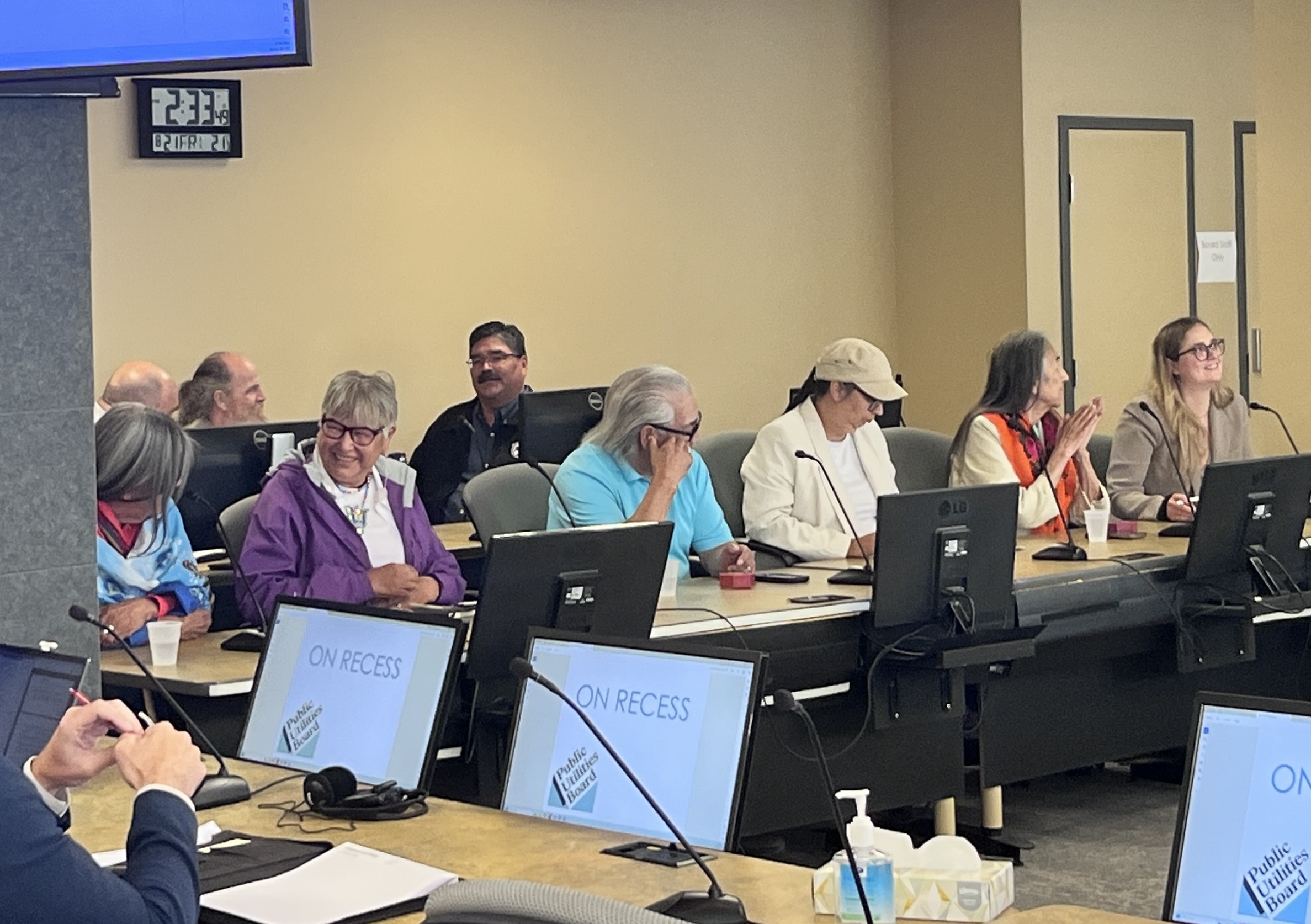
Photo: Wa Ni Ska Tan’s Witness Panel preparing for the panel session at the public hearing.
From left: Elder Rita Monias (Pimicikamak Nation), Melanie Molin (Mathias Colomb Cree Nation), Mervin Garrick (Pimicikamak Cree Nation), Tanya Dawn McDougall (St. Theresa Point Ansininew Nation), Elder Nelliane Cromarty (St. Theresa Point Ansininew Nation), and Elder Ellen Cook (Misipawistik Cree Nation), who participated virtually.
On August 21st, Wa Ni Ska Tan presented evidence during the public hearing, bringing Indigenous voices into the review process. Dr. Stéphane McLachlan (University of Manitoba), Daniel Gladu Kanu (Lake Winnipeg Indigenous Collective), and Leslie Dysart (Community Association of South Indian Lake) gave presentations, providing recommendations to support productive, future-oriented discussions for energy planning that reflect community voices while recognizing the past and ongoing harms caused by hydroelectric dams.
Wa Ni Ska Tan’s participation also included an Indigenous witness panel to share their knowledge, lived experience, and recommendations. These contributions will help the Board more meaningfully reflect the perspectives, priorities, and needs of hydro-impacted communities in northern Manitoba in their recommendations to the Province.
On September 4th, Wa Ni Ska Tan gave a closing remark during the public hearing. We highlighted the definition of safe, reliable, and affordable energy for the First Nations in Manitoba, the meaning of economic reconciliation, Manitoba Hydro’s duty to consult, and the importance of recognizing past and ongoing harms caused by hydropower developments in the IRP review process.
Wa Ni Ska Tan concluded our closing with the words of the Grid-Strong Nation-Strong Report: “When First Nation communities are safer, stronger, better housed, better prepared and more meaningfully involved in energy planning, the result is a more stable, more durable and more accountable energy future across Manitoba as a whole.”
You can find Wa Ni Ska Tan’s closing remarks on Transcript page 6106 – 6139 (click here).
Thank you to everyone who supported Wa Ni Ska Tan’s work in the IRP review process. We will continue to work for better Indigenous engagement, involvement, and consultation processes in energy planning to meaningfully reflect community perspectives and needs.
*All Wa Ni Ska Tan’s evidence is available on the Public Utility Board’s website
(click here)